
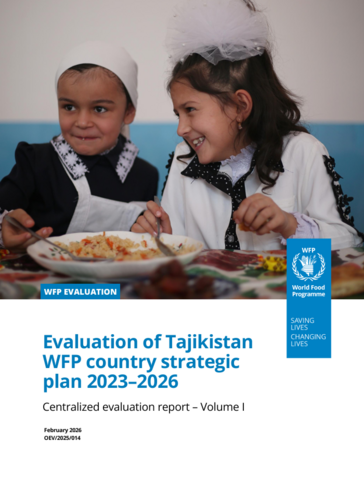
Despite its 2021 transition to lower‑middle‑income status, Tajikistan remains highly exposed to external and climate shocks. Food insecurity is widespread, and structural agricultural constraints, recurrent natural hazards and pervasive poverty continue to erode household resilience. WFP’s country strategic plan is aligned effectively with national priorities through four outcomes related to food security, nutrition, resilience and emergency preparedness.
What worked – or didn’t – and why?
The evaluation found that WFP’s strategic positioning in Tajikistan was adequately underpinned by strong analytical foundations and regular food security monitoring. The shift towards system strengthening, particularly in school feeding, nutrition, climate services and emergency preparedness, reflected WFP’s comparative advantages and contributed to increased national ownership. However, engagement in social protection and food systems remains at an early stage, largely constrained by resource limitations and project-based funding.
The school meal programme continued to serve as one of the country’s largest social safety nets, although pipeline and procurement delays reduced the number of feeding days and led to reliance on community contributions. Nutrition programming delivered high rates of recovery from moderate acute malnutrition, but its geographic coverage remained limited owing to funding constraints.
Resilience‑building interventions generated positive outcomes in remote, climate‑affected areas. Institutional capacity strengthening at the national and district levels improved climate information services and contributed to integrating climate risks into local development plans. However, scale remained below expectations on account of delays in cash-based transfer systems, limited access to financial services and inconsistent funding flows. Cross‑cutting areas showed uneven progress.
What should WFP do?
The evaluation made four recommendations for WFP’s next country strategic plan:
- Position WFP as a systems enabler in Tajikistan’s evolving social protection framework by operationalizing its value proposition through a systems lens;
- Strengthen WFP’s internal organizational arrangements, including mapping and identifying bottlenecks, streamlining internal decision-making processes and empowering national staff;
- Consolidate and contextualize WFP’s climate portfolio; and
- Promote and advocate the integration of home-grown school feeding approaches into the national school feeding programme, supporting its scalability and sustainability.