
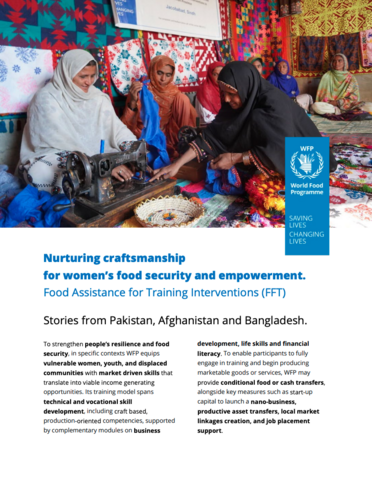
To strengthen people’s resilience and food security, in specific contexts the World Food Programme (WFP) equips vulnerable women, youth and displaced communities with market-driven skills that translate into viable income generating opportunities.
Its training model spans technical and vocational skill development, including craft-based, production-oriented competencies, supported by complementary modules on business development, life skills and financial literacy. To enable participants to fully engage in training and begin producing marketable goods or services, WFP may provide conditional food or cash transfers, alongside key measures such as start-up capital to launch a nano-business, productive asset transfers, local market linkages creation, and job placement support.