
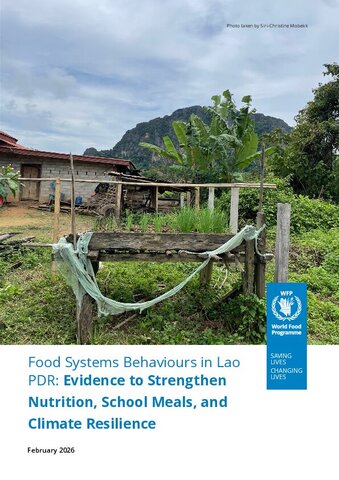
Despite progress in recent years, undernutrition remains a persistent challenge in Lao PDR, particularly among rural, low-income and ethnic groups. While nutrition knowledge and motivation have improved, food choices and nutrition outcomes continue to be shaped by poverty, seasonal food availability, time scarcity, gender roles and exposure to low-cost ultra-processed foods. This study situates nutrition behaviours within food systems and broader social and institutional environments, to understand why gaps between knowledge, intent and practice persist.
Guided by the Socio-Ecological Model, the research analyses behavioural drivers and barriers across individual, household, community, institutional and structural levels, tracing behaviours along key
journeys related to nutrition, school meals and climate-resilient, small-scale farming.
Its findings are intended to inform more inclusive, context-responsive strategies that strengthen food systems, improve nutrition outcomes and contribute to a healthier and more food-secure population in Lao PDR.
WFP. 2026. Food Systems Behaviours in Lao PDR: Evidence to Strengthen Nutrition, School Meals, and Climate Resilience. Rome
| Document | File |
|---|---|
| Reaching the Most Vulnerable: An Intersectional Analysis of Nutrition Barriers in Lao PDR |
PDF | 8.77 MB
Download
|
| Balancing Food, Work, and Risk: Gendered Behaviours in Nutrition, School Meals, and Climate-Resilient Farming in Lao PDR |
PDF | 7.37 MB
Download
|
| Advocacy Brief Nutrition Is Collective Action: Advancing Equity, Coordination and Systems Reform in Lao PDR |
PDF | 18.79 MB
Download
|
| Policy Brief: Embedding Social and Behaviour Change within Food Systems Governance in Lao PDR |
PDF | 15.78 MB
Download
|
| Media & Science Communication Toolkit |
PDF | 12.7 MB
Download
|