
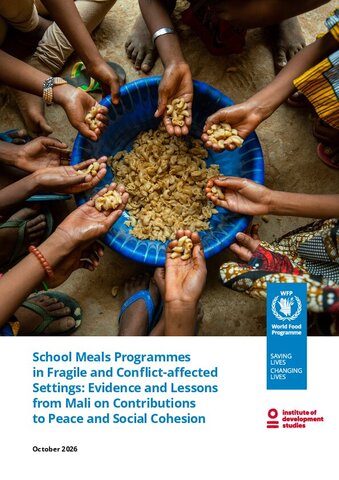
Building on the 2025 WFP-IDS framing paper on school meals, contributions to peace and social cohesion in fragile and conflict-affected settings, this report explores how school meals may contribute to social cohesion in Mali. Drawing on field research conducted jointly by WFP and IDS in four schools in Bandiagara and Mopti, Mali, the report examines whether and how the pathways identified in the framing paper manifest in practice, and assesses the extent to which the school meals programme is grounded in a conflict-sensitive approach.
The findings suggest that school meals help restore a sense of normality, stability and hope for children affected by insecurity and displacement, support enrolment and school attendance by reducing the burden of household poverty, and foster interaction among children from different backgrounds through the shared experience of eating together.
Overall, the report finds that school meals support important building blocks of social cohesion, while highlighting opportunities to strengthen conflict-sensitive programming and the intentional integration of secondary social cohesion outcomes into school meals programme design and monitoring.
WFP and IDS. 2026. School Meals Programmes in Fragile and Conflict-Affected Settings: Evidence and Lessons from Mali on Contributions to Peace and Social Cohesion. Rome.