
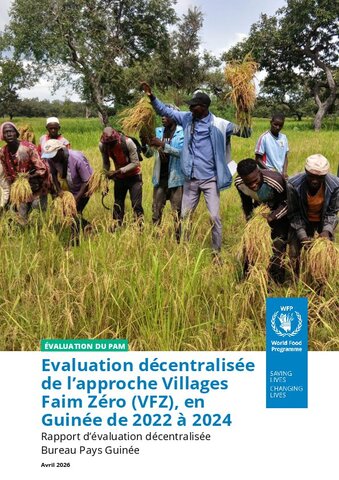
The evaluation will support learning and accountability for the WFP Country Office, national partners and other stakeholders, with a view to scaling up the approach and informing the next Country Strategic Plan. Data collection took place in May 2025, combining document review, key-informant interviews, focus group discussions and field observations.
The Zero Hunger Villages approach is implemented in a context of persistent food insecurity and malnutrition in Guinea despite strong natural resources. It is an integrated, multi-sector package spanning resilience and agricultural production support, school feeding and nutrition services. Overall, the evaluation finds the approach relevant to community needs and aligned with national and WFP priorities, and notes positive—though sometimes fragile or insufficiently documented—effects on food security, livelihoods and community dynamics. Key constraints highlighted include uneven adaptation to local contexts, procedural complexity affecting implementation, and gaps in strategic framing, monitoring, evaluation and exit planning that may limit sustainability and the ability to demonstrate results at scale.