
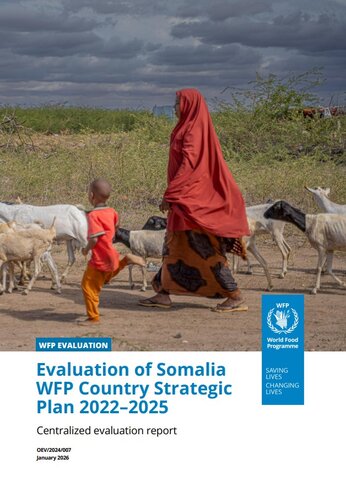
The country strategic plan prioritized humanitarian response while aiming for resilience building, livelihoods and government capacity strengthening in line with national and United Nations frameworks. WFP's role in famine prevention during the 2021–2023 drought, when it swiftly scaled up food and cash assistance, exceeding targets and stabilizing food insecurity, was its primary achievement under the CSP.
Furthermore, WFP delivered conditional and unconditional assistance, notably through a shock responsive safety net project funded by the World Bank, which was handed over to the Government in 2024. Funding gaps constrained school feeding and nutrition programming. WFP aimed to build resilient food systems and enhance farmers' market access, but limited funding and logistical challenges constrained programme achievements. WFP bolstered government capacity but took a broad approach that spread resources thinly, hindering the strategic focus and sustainability of initiatives.
The evaluation makes five recommendations for the next country strategic plan and its implementation. The recommendations focus on:
- strengthening programme integration;
- improving programme design based upon realistic resource assumptions;
- improving data use to enhance programme design;
- clarifying the strategic purpose of partnerships; and
- enhancing the strategic focus of and rationale for government capacity strengthening.
WFP. 2026. Evaluation of Somalia WFP Country Strategic Plan 2022-2025.
| Document | File |
|---|---|
| Summary evaluation report (English) |
PDF | 828.02 KB
Download
|
| Summary evaluation report (French) |
PDF | 1.09 MB
Download
|
| Summary evaluation report (Spanish) |
PDF | 1.12 MB
Download
|
| Summary evaluation report (Arabic) |
PDF | 1.27 MB
Download
|
| Post-hoc quality assessment |
PDF | 156.28 KB
Download
|