
Lessons from the rains: Call for unfettered access to tackle winter hunger in Gaza
Winterization – preparatory actions to get people through the cold months – is the next urgent challenge for humanitarian organizations in Gaza, said Kate Newton, Deputy Country Director for the World Food Programme (WFP) in Palestine.
Since October’s ceasefire agreement conditions have improved – the risk of famine is currently reducing in Gaza, but varied and fresh food sources are still in short supply while scale and consistency are sorely lacking.
“We need full, unfettered humanitarian access.”
Food, medical supplies and tents are not making their way into the territory in sufficient amounts amid fears that continued fighting, in spite of the announced ceasefire, may result in another blockade.
That prospect is unthinkable in a context where 56 percent of people do not have sufficient access to drinking water and 72 percent of people use improvised toilets. In addition to malnutrition, children face respiratory infections, diarrhoea, and skin diseases.
“We still have all the issues that we’ve been talking about for months and months – the logistical challenges, the fact we’re very limited in terms of the number of roads we can use, that we still have a very high level of insecurity, that bureaucratic processes are still impeding humanitarian delivery,” said Newton.
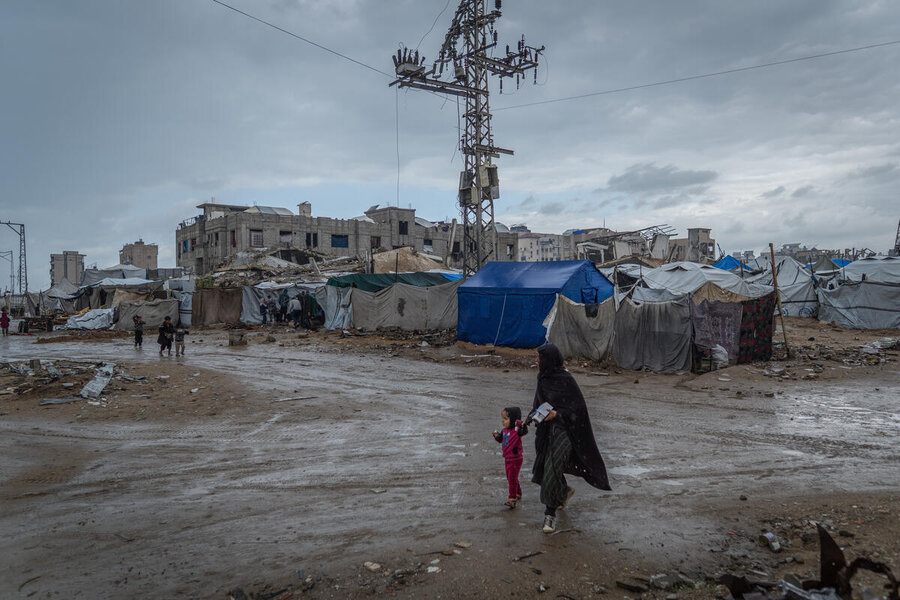
Meanwhile, “anything that’s considered a ‘dual-use’ item” such as “tents with aluminium frames and mobile storage units … items that are just essential inputs for basic rehabilitation of infrastructure to help the recovery effort … we can’t bring in, even spare parts for our trucks.”
Insufficient security remains a problem, too, as it allows looting to persist. “It’s still a difficult, dangerous thing, just delivering food into Gaza,” said Newton.
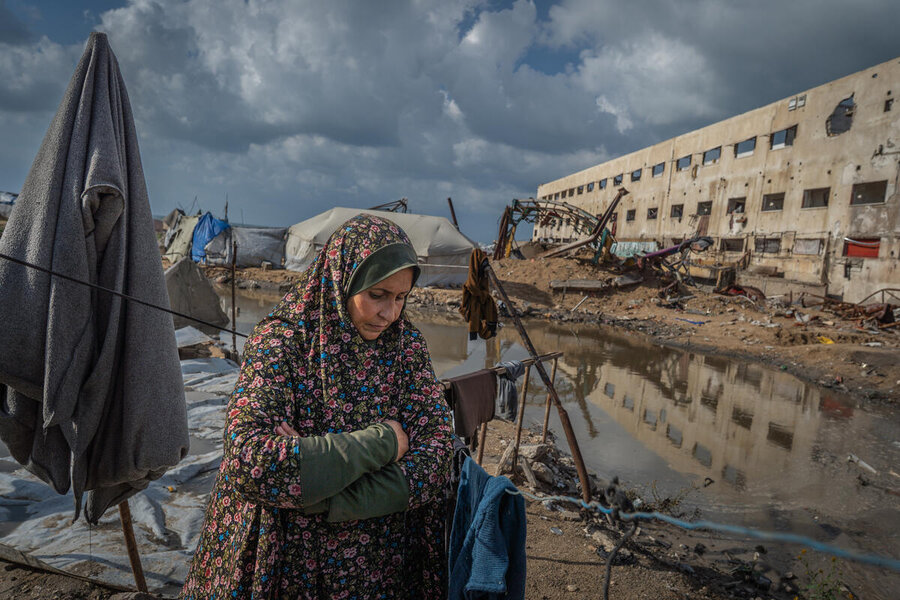
In a sign of a deepening crisis during the winter, heavy rains in mid-November released sewage out of dugout drains, making life next to impossible for communities of displaced people living in tents along the coastline – around 13,000 households were affected, according to OCHA.
“Most of the population have been displaced from their homes, access to basic necessities and basic services is limited and sometimes non-existent. And obviously bad weather makes that much worse,” said Newton. With worse weather possibly around the corner, “this is a moment to remind the broader community that we really do need to accelerate the pace at which we can get in more shelter, more food items, in addition to all the food.”
While “WFP is working with partners to try to deliver everything in advance of the winter, trying to make sure that people have blankets and clothes and mattresses and anything they need,” she added, “the conditions are just pretty awful.”
These challenges play out in the lives of families who have already lost almost everything. Below are two voices from displaced families in Gaza City, to whom WFP supplied sandbags, recalling the rains in mid-November.
Hadeer
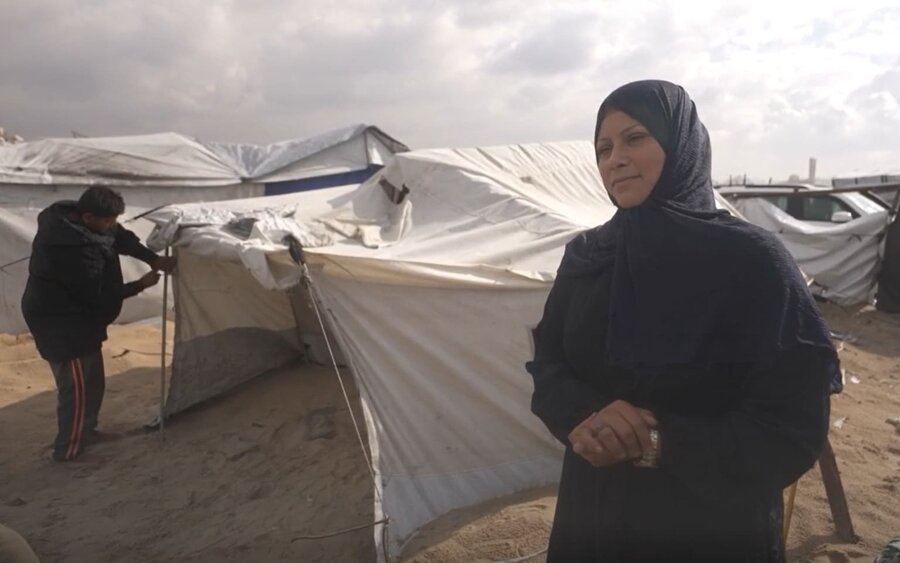
They were warning us that a new storm was coming. We secured the tent as much as we could, tightened it down. We spread rugs, mats, everything so it would hold up for the winter. We put barrels around it so the rain wouldn’t get in. But we were shocked by how strong the wind was.
Strong winds came and blew everything away. We couldn’t stay inside the tent. Our clothes got soaked, everything we owned got soaked. The kids’ clothes – everything got wet, and we couldn’t stay there. We left the tent until the wind calmed down and waited for the sun to rise.
The wind was dragging us – me and my children – pulling us. The sand blew into our eyes; we couldn’t handle it, truly we couldn’t.
At some point I felt like I had to sit down inside the tent, but we ended up running out. All the blankets were soaked. Our food and firewood – everything.
My daughters’ clothes – these clothes they’re wearing now – everything got drenched. All our things were filled with water. We left and went to my brother’s place for a bit, until the rain eased and we could dry some of our belongings and go back to the tent.
We couldn’t cook. We ended up eating just bread with za’atar because we had nothing to burn for cooking. All of our food turned into liquid. At night, you find the children freezing from the cold, from the wind and the chill. My son gets diarrhoea, vomiting… ever since we arrived here two months ago, he hasn’t recovered once.
It’s extremely cold. We’re in a kind of basin – the sea surrounds us from three sides. There’s nothing in front of us to protect us from the wind or the cold.
My tent is broken. I kept telling myself it would survive the winter. We’ve had it from the beginning of the war. It’s torn from all the moving around. What can we do? This is our life.
Nayeb
When I first arrived here, they sent me a message about a coupon and told me to go to Khan Younis. That was when I first arrived, but I couldn’t go because of the situation and the costs. After about two weeks or maybe a month, they sent me a box with rice and lentils. Other than that, I haven’t received anything.
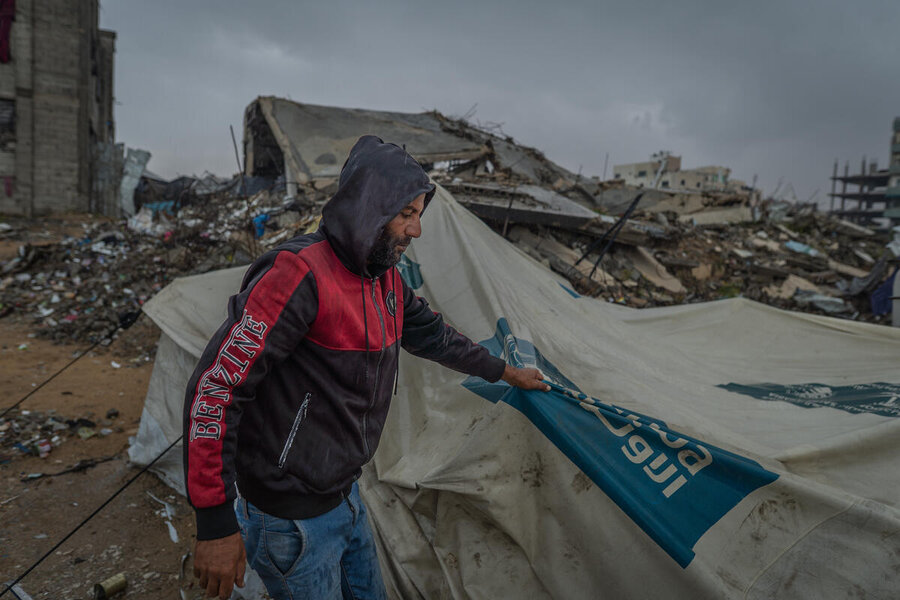
All the supplies are ruined, and the mattresses are damaged. Nothing is left. As you can see, the winter came with heavy rain, flooding everything. The mattresses, blankets, and food supplies like flour – all soaked and gone. Honestly, I have no means. I have no one. It’s just me, my wife, and my children. Right now, the situation is very hard. We are five people – three kids and my wife.
Since October 7 until today, I’ve been living in a tent, suffering with my children, moving from place to place. This tent I got from someone. I’ve suffered enough. Two or three years now, and still the same struggle. I keep moving from one place to another, trying to find land to put my belongings on – maybe 13 times altogether.
From the Shati’ Camp to Sheikh Radwan, to Al-Shifa, to the north, to Jabalia Camp, to Old Gaza, then to tents, then to Khan Younis, then to Al-Qarara, then to Asdaa, then back again where people kicked us out, then to Hamad, and finally to Rafah.
Even now, I’m still paying off displacement costs. It’s all debt upon debt. I’ve been humiliated just to keep my kids safe from danger. Every time I settle, they tell me to leave. I don’t know where to stay or where to go. It’s all chaos – nothing changed except that the suffering continues.
Here, on the mattress on the ground, I’ll lay it out and sleep on it. This place hasn’t been safe for three years. Tonight won’t make a difference. I’ve gotten used to this life, unfortunately.