
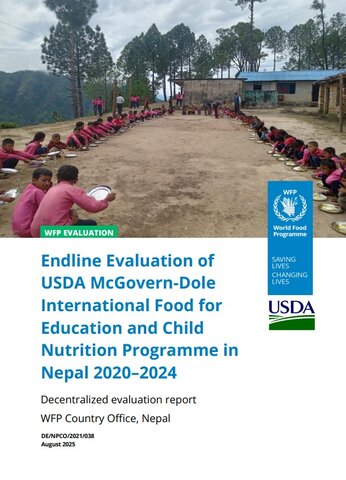
This decentralized evaluation was commissioned by WFP Nepal Country Office and covers the endline evaluation of the 4th cycle of the USDA McGovern-Dole International Food for Education and Child Nutrition Program covering the fiscal years 2020-2024.
The evaluation was carried out from August 2024 to August 2025 to provide an evidence-based, independent assessment of the performance of the McGovern-Dole project by objectively assessing the implementation and achievements for accountability and learning. It focused on assessing relevance, coherence, effectiveness, efficiency, impact, and sustainability.
The key activities covered by the evaluations include food distribution, Improvement of Safe Food Preparation, Handling and Storage, provision of integrated package for school health and nutrition improvements, promotion of improved literacy, improved nutrition and institutional capacity strengthening.
- Relevance: The FY20 McGovern-Dole project addressed food insecurity, poverty, and absenteeism in six remote districts through midday meals, school health and literacy services, and local cooperatives to boost agriculture. Implemented in partnership with the Ministry of Education and local governments, it improved education, reduced inequalities, and strengthened production systems. Over 81 percent of parents credited the project for better attendance, and stakeholders noted gains in enrollment, health, and sanitation.
- Coherence: Initially aligned with Nepal’s long-term policies - National Education Policy 2019, the 15th Development Plan, and the Multi-Sector Nutrition Plan II - the project remained coherent with newer frameworks such as the School Education Sector Plan (2022/23–2031/32) and Multi-Sector Nutrition Plan III. Government actions to scale midday meals to grade 8 and issue the Local Production-Based Nutritious Midday Meal Program Framework 2024 confirm strong policy alignment. While not explicitly rights-based, activities reinforced governance, accountability, and socially responsible partnerships.
- Effectiveness: Despite COVID-19 disruptions, the project met 59 percent of end targets and partially achieved 41 percent, with improvements across all 29 indicators. Parent interviews confirmed 99 percent school attendance, reduced early returns, and high satisfaction. WFP’s dual approach - working through local governments and engaging NGOs - was effective, reflected in local government capacity gains.
- Efficiency: The evaluation found the project efficient, with no cost overruns and a reasonably low cost per beneficiary, excluding external costs and WFP management fees. Expenditure on capacity strengthening was less efficient. WFP’s desk-based technical assistance significantly boosted implementing agencies’ capacity, fostering cooperation, strengthening government relationships, leveraging external opportunities, addressing resource gaps, and sharing experiences.
- Impact: The project reduced discriminatory practices and shifted gender roles such as providing a high priority to boys in meals, acting as a catalyst for long-term change. By engaging parents, strengthening school-community ties, and improving educational outcomes, it promoted gender equality through universal targeting, cooked meals, menstrual hygiene support, and coordination with health facilities. Additional efforts - training, workshops, and economic opportunities for women farmers - further advanced empowerment and household income.
- Sustainability: Basic concepts of integrating midday meals with complimentary activities have been endorsed by the long-term School Education Sector Plan (2023-2031), Multi Sector Nutrition Plan III (2023-2031) and Sixth Plan (2025-2029). Community participation remained relatively better in the non-transitioned districts with regular monitoring and training. The Organizational Performance Index was comparatively higher in non-transitioned districts.
Key recommendations:
- Food distribution: Strengthen collaboration among local communities, governments, and schools to identify and address factors affecting student attendance and retention with specific focus on improving the quality and regularity of midday meals.
- Support improved safe food preparation, handling and storage: Improve cooking facility and infrastructure at schools, including capacity of persons involved in food management and distribution.
- Integrated School Health and Nutrition package: Strengthen integration of school health and nutrition (SHN) interventions at schools based on revised SHN strategy.
- Improved literacy: Strengthen capacity of the local government and schools on early grade teaching practices.
- Improved nutrition: Collaborate with the local government to promote and strengthen HGSF.
- Capacity strengthening: Strengthen institutional capacity of local governments on planning, implementation and monitoring of mid-day meal program.