
School snacks help children cope with hunger and disrupted education in Gaza
Tell me about this photograph and why it’s significant.
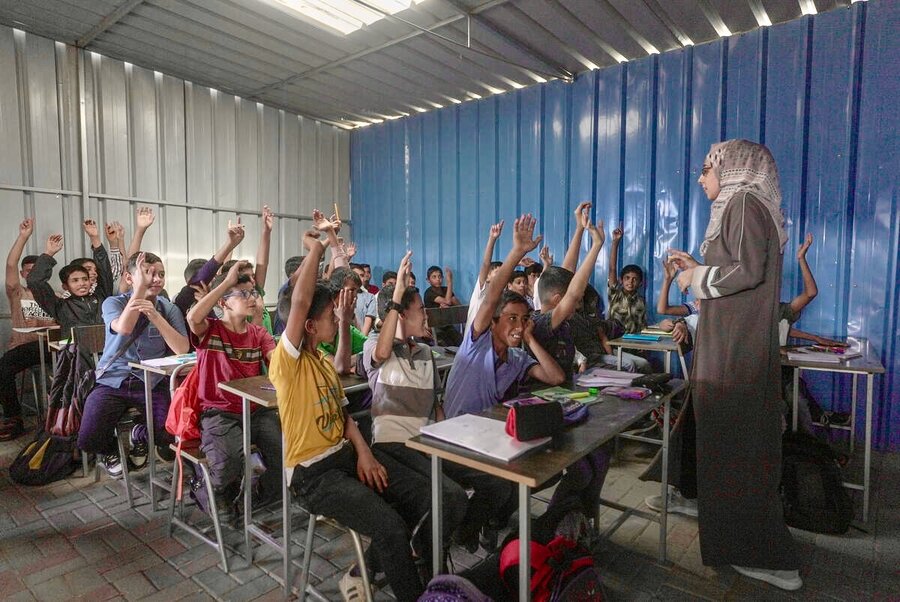
Education is very important for us as Palestinians. But schools are not what they used to be. So many buildings have been destroyed. A number of children have returned to ‘school’ — actually makeshift classrooms — since the last ceasefire agreement.
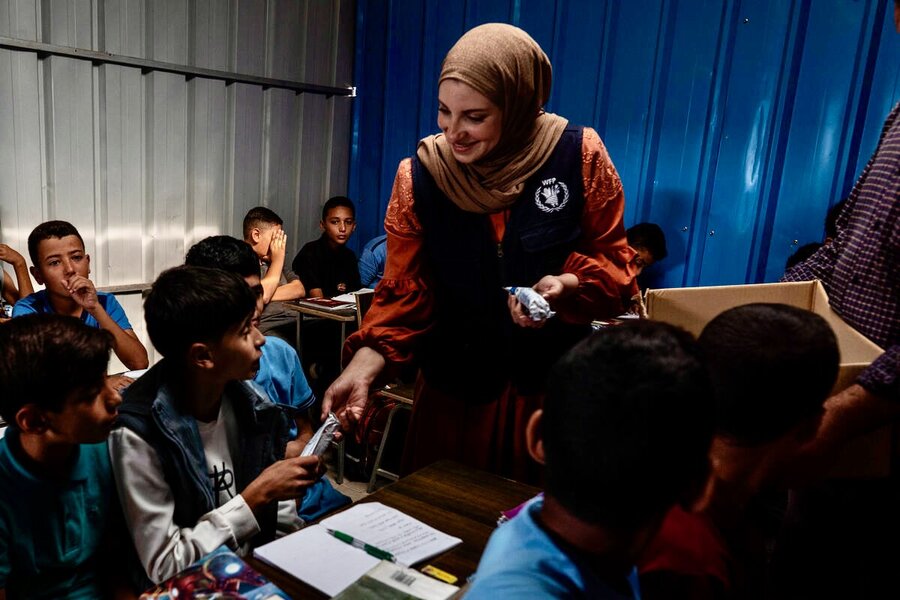
And they were happy to receive the fortified snack bars?
The fortified snack might seem small, but it has a big impact — it helps children focus, participate, and even encourages attendance. Children are creative. When they have food, a safe place and some stability, their imaginations start running wild again.
During the war, many children took on adult responsibilities — carrying water for their families, collecting firewood, searching for food or wheat near the border. Some lost parents or became heads of their households. Returning to temporary learning spaces [TLS] helps free their minds from those burdens. It reminds them: ‘You are a child, your job is to learn and dream.’ That sense of stability will take time to return. But this is a start.
"You are a child, your job is to learn and dream."
How did you feel that day yourself — as a Gazan and as a UN professional — when you were distributing food for the first time?
I was really happy. You know, we live the same situation as everyone here. We face the same shortages, the same challenges. We understand what people go through every day.
For us, the most important thing is to help children grow up stable — to give them a chance to continue their education. Mothers especially think a lot about their children’s futures, about how they can study, how to support them and how to help them build a successful path towards becoming who they dream, whether doctors, engineers or anything else.
Tell me about your actual job. How does it connect to the food deliveries?
I work in the Nutrition programme, which links closely with TLS. We run additionally two main nutrition programmes in Gaza. One is the Blanket Supplementary Feeding Programme, to prevent malnutrition among pregnant and breastfeeding women and children under 5. The other is the Targeted Supplementary Feeding Programme, for those who are already malnourished. [Alongside this, WFP provides cash and food assistance to support the most vulnerable and improve health and stability].
At the start of 2025 there was a ceasefire, then bombing began again, and now another ceasefire. How does that feel on the ground, and how optimistic are you right now?
It’s hard to describe. Every time there’s talk of a ceasefire, we wait weeks or months, and sometimes it doesn’t happen. When it finally does, there’s relief — but also fear it might end again.
Some goods are appearing in the market, though prices are very high. Most people can’t afford them. The war has affected every part of life — education, health, shelter, even clean water and sanitation. Many still live in tents, with poor hygiene and disease.
So yes, there are many difficulties. But safety is the most important thing. During the war, you couldn’t walk outside without fearing a sudden bomb. The ceasefire gives us calm, lets us move freely within about half of the territory. That’s the first step.
We’re not yet optimistic, but we are trying to plan for recovery. It will take time.
"The fortified snack might seem small, but it has a big impact – it helps children focus, participate, and even encourages attendance."
And in terms of food access, what was the most difficult moment for you?
During the war, there were long periods when fresh food was incredibly scarce. Even basic items almost disappeared from the markets. People survived on dry food for months, without fruit, vegetables, meat, eggs or fish.
Even when something was available, prices were impossible. A few vegetables might appear, grown locally, but few could afford them.
It went on for months — from around March until October. Many suffered weight loss and malnutrition. We saw this clearly among pregnant and breastfeeding women and young children, especially under-5s. Recovery from that takes a long time.
What would you like to see happen in the next six months, particularly in your nutrition work?
I hope the ceasefire continues so we can reach more people in need and start genuine recovery. I want to see improvement in nutrition and no more malnourished children, women or adults in Gaza. That’s my hope.
You seem a very calm person, even in such a testing environment.
To be honest, I try to think differently. I understand the challenges WFP faces here. During the famine, for example, there were times when supplies weren’t allowed to enter Gaza.
We kept working with what we had, using our limited resources in the best way, reaching those most in need. I saw how hard my colleagues worked, how they communicated and advocated every day. I’m proud to be part of WFP, proud of how we adapt and continue to serve people in such a difficult context — which feels like the most difficult in the world.