
From aid to autonomy: how refugees and host communities are building food security in Chad
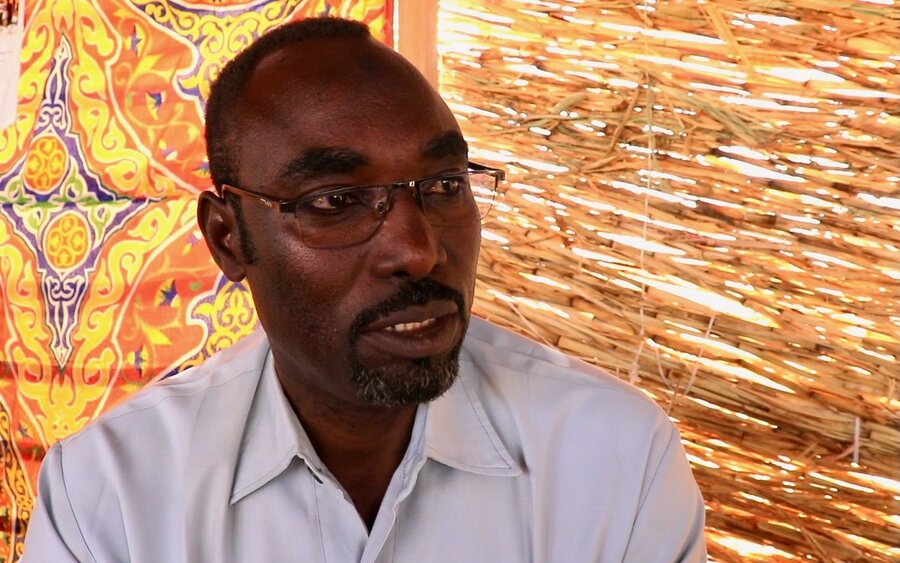
It’s a hot morning at the Metche refugee camp in eastern Chad, even inside the rough shelter where Faical waits with other Sudanese refugees to collect World Food Programme (WFP) food assistance. Bright bars of sunlight filter through woven bamboo walls onto the dry dirt floor.
“This support has profoundly improved our living conditions,” says Faical, his face serious behind wire-frame glasses. “But what’s important to me now is to work for this country. To serve Chad.”
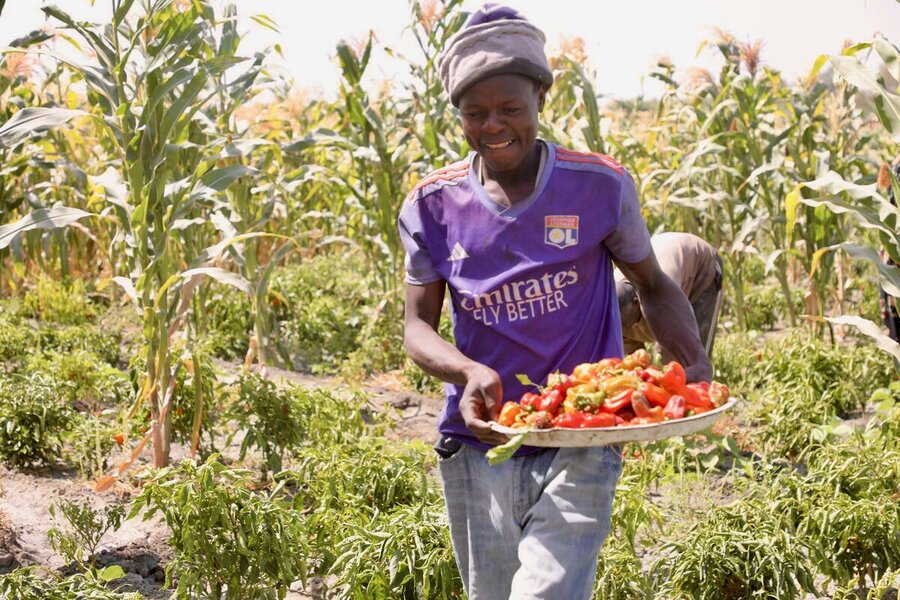
Just a few dozen kilometres north, a farmers’ collective of 375 refugees and Chadian families is doing just that, at the WFP-supported Loumba-Massalit market garden. The site, a couple of hours from the Sudanese border, feels a world away from the sand-coloured landscape of Metche. Women carry a long irrigation hose through their lush green beds of crops, shaded by rows of broad leafy trees.
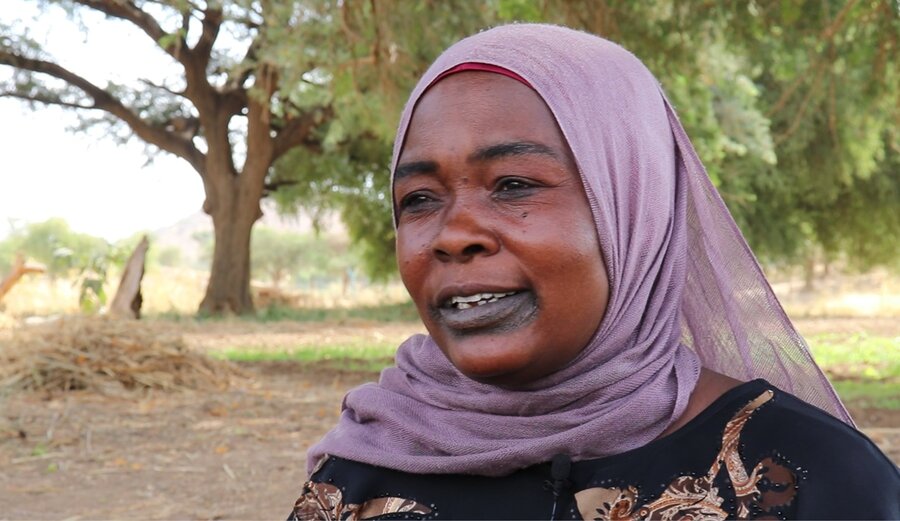
“This project has given us a great opportunity,” beams group member Mahassine. “Before, I looked in vain for work. Now, I work all day to earn at the end of the month.”
"Before, I looked in vain for work. Now, I work all day to earn at the end of the month.” – Sudanese refugee Mahassine of a WFP-supported farming project
Faical and Mahassine count among 1.5 million asylum seekers sheltered by Chad, one of Africa’s largest refugee host countries. The vast majority are Sudanese, including 900,000 who, like Faical, arrived since the start of their country’s civil war in 2023. Mahassine came in 2004, as another brutal conflict swept through Sudan’s western Darfur region.
While Faical counts among more than a million people in eastern Chad receiving WFP’s emergency food and cash assistance, our support for Mahassine and her farming group is different. It empowers them to build the foundations for self sufficiency, through initiatives like constructing water infrastructure and growing food crops.
“WFP is helping to drive a fundamental shift in Chad: from food relief to sustainable development,” says Sarah Gordon-Gibson, WFP Country Director in Chad. “This transition is crucial for long-term food security. It’s a strategic, cost-effective way to reduce the resources needed for humanitarian aid, invest in local economies and ensure self-sufficiency”.
That shift reflects Chad’s broader national development plan which aims, among a raft of goals, to unlock the agropastoral potential of the Central African country, with its rich subsoil and 39 million hectares of arable land. It can also be a powerful, long-term deterrent to widespread food insecurity in Chad, where one in six people faces crisis or emergency-level hunger, fuelled by displacement, underdevelopment and recurrent weather shocks like droughts and floods.
From assistance to resilience
The Government’s Haguina approach, using the Chadian Arabic term meaning “it is ours,” brings together multiple projects with the shared goal of self-sufficiency, through stronger market linkages, durable infrastructure and increased agricultural productivity – including on parcels of land allocated to families. Its five-year goal is to empower a million people, both refugees and Chadians.
WFP, along with partners including other United Nations agencies, works across Chad to implement many of these Government-led projects. A major focus is making land productive and rehabilitating or building infrastructure, through a mix of programmes providing food assistance to communities taking part in this work, combined with directly deploying our own engineering expertise.
“WFP is helping to drive a fundamental shift in Chad: from food relief to sustainable development.” – Sarah Gordon-Gibson, WFP Country Director in Chad
“WFP is committed to supporting the Government of Chad through Haguina, and we commend its leadership in this initiative,” says WFP’s Gordon-Gibson. “We are convinced that this is the right approach for Chad: moving beyond humanitarian assistance towards durable solutions that will build resilience and foster development.”
The shift to self-sufficiency is all the more important today, as a humanitarian funding crunch puts traditional food assistance under increasing pressure. For many vulnerable people, that food assistance is no longer enough.
“We received food every month: millet, salt and oil, among other things. Today, all this assistance has been replaced by cash,” Faical says. “We want an increase in the amount of cash to better cope with the high cost of living.”
That’s part of the reason he wants to work in a project like Mahassine’s: to make his own life in Chad. He has no intention of returning to Sudan, he adds, until the situation there improves.
At the Loumba-Massalit site alone, WFP support under Haguina has enabled participants like Mahassine to develop 19 hectares of market garden plots – the size of about 27 football fields – plant 13,000 seedlings and build 30 hectares of half-moon water catchments capturing precious rainwater.
The harvests by Mahassine’s farming group, ranging from tomatoes to okra, garlic to rocket, beetroot to potatoes, amount to a real business yielding enough money to meet her family’s needs – including school supplies for her children.
She’s keen to see the WFP project expanded, and for her group to continue even after it ends. She’d like to invest in livestock, which would bring in more profits, so she can provide even more for her children.
“Especially for their education,” Mahassine adds, “so that they can take care of me when I am old.”
WFP’s work in Chad is made possible by the support of donors including Austria, Belgium, Canada, the Church of Jesus Christ of Latter-Day Saints, Denmark, the European Union, Finland, France, Germany, Italy, Japan, Korea, Lichtenstein, Luxembourg, the Netherlands, Norway, Sweden, Switzerland, the United Kingdom, the United States of America and the World Bank.