
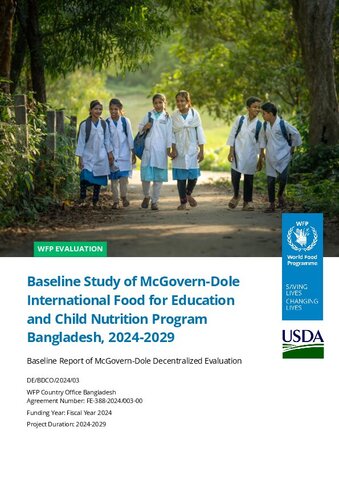
The decentralized evaluation was commissioned by the Bangladesh CO as the Baseline study of the USDA McGovern-Dole International Food for Education and Child Nutrition Project in Bangladesh, and was carried out in 2025. The baseline study established baseline values for all the performance indicators in the Performance monitoring Plan and documents baseline conditions for each relevant evaluation question before the project commencement, in support of accountability and learning for evaluability and adaptation.
The evaluation covered project activities including provision of school meals, institutionalization of supplementary reading programmes, WASH interventions, establishment of school gardens, capacity strengthening of teachers and smallholder farmers in 149 Government Primary Schools (GPS) and communities in Madhabpur upazila, Habiganj district (Sylhet Division). In addition, the project provides technical assistance to 140 GPS in Ukhiya and Kutubdia upazilas, Cox’s Bazar and national-level institutions.
The key findings include:
- Relevance: he FY24 McGovern‑Dole project strongly aligns with Bangladesh’s national priorities in education and social protection, including the National Education Policy, the National School Meals Policy (NSMP), and the Primary Education Development Programmes, as well as priorities related to agriculture and hygiene. Stakeholders at both national and sub‑national levels view the project as directly addressing key priorities such as improving learning outcomes, nutrition, and attendance, while noting that teacher workload and infrastructure constraints may affect implementation.
- Coherence: The project demonstrates coherence with the Government of Bangladesh’s priorities and other donors’ programmes such as World Bank supported Quality Learning for All Program (QLEAP). The project collaborates with partners such as Room to Read (RtR), Center for Natural Resource Studies (CNRS), and the Food and Agriculture Organization (FAO). Despite overall complementarities observed, some stakeholders noted scope to further strengthen alignment in the literacy component. Coordination mechanisms between WFP and government institutions have been established to support joint monitoring visits and to promote data sharing and joint accountability.
- Effectiveness: The baseline findings indicate low literacy levels among Grade 3 learners, with weak decoding and reading fluency. While enrolment shows a declining trend, retention rates remain strong. Between 16 and 19 percent of teachers reported that more than 15 students in their classes experience difficulties concentrating during classroom learning, with this challenge more pronounced in rural areas. Attendance is generally good, although short‑term absences due to ill health, household duties, and weather‑related factors are reported. While students and parents demonstrate good awareness of education and hygiene practices, the consistent application of these practices remains uneven. Teacher training coverage remains uneven with limited exposure to reading-promotion and library management. At national and local systems show moderate overall readiness to deliver school feeding programme. Infrastructure, logistics, human capacity, and community engagement are generally functional but require strengthening, particularly in storage, staffing, and structured community roles. Multi-sectoral coordination remains weak and largely informal.
- Sustainability: The government has advanced policy commitments toward a national school feeding programme; however, implementation remains partial and continues to be supported by development partners. Current efforts include refinement of the NSMP and implement local procurement models under the combined weekly menu approach, which introduces diversified, nutritious food options such as eggs, fruits, and milk. Findings indicate that smallholder farmers in Madhabpur have the potential to supply eggs and fruits but currently face constraints in scale, storage, and coordination. Engagement with local actors, including education officers, School Management Committees, Parent–Teacher Associations, and planned mothers’ groups, remains a critical success factor for sustaining programme implementation.