
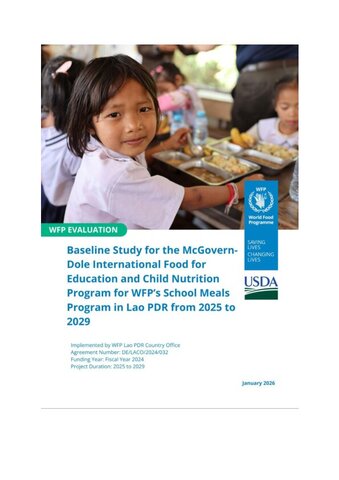
The baseline study was commissioned by the WFP Lao PDR and covers the Baseline Study of the World Food Programme (WFP) McGovern-Dole International Food for Education and Child Nutrition project in Lao PDR from 2024 to 2029. The study is carried out to serve as a baseline assessment prior to the start of the FY24 project implementation and has a dual purpose of accountability and learning. It was conducted in the period between July and November 2025.
The project activities include the provision of school meals; literacy activities; school‑based social behavior change interventions on WASH and nutrition; safe water and clean cooking technology activities; government capacity strengthening; community engagement; and health and nutrition activities across 17 education priority districts in 11 provinces in Lao PDR.
The key findings from the evaluation include:
- Relevance: The FY24 project is strongly aligned with Lao PDR government policies, WFP’s CSP 2022-2026, and the UNSDCF 2022-2026, supporting national priorities on education, nutrition, school meals, and health and nutrition. Building on FY20 project cycle, the project remains relevant to community and school needs through integrated school meals, WASH, literacy, and nutrition activities. The project also supports the transition to the National School Lunch Program through strengthened systems, capacity, monitoring, and community engagement. However, clearer articulation of intermediate pathways, capacity strengthening processes, and sustainability assumptions is still needed to support long- term transition and implementation success.
- Effectiveness: The baseline assessment shows that the FY24 project design is broadly appropriate to deliver intended results, while seven Life of Project indicator targets require adjustment based on actual baseline conditions. Literacy and dietary diversity outcomes remain low, particularly in remote areas, while attendance rates are high across project schools. Wash conditions show continued gaps in access to improved water, soap, and consistent hygiene practices. Students demonstrated moderate knowledge of healthy diets and handwashing, but practices remain weaker, while caregivers reported strong nutrition-related knowledge and behaviours. The monitoring system, including the Lao School Meals App and standardized reporting tools, provides a solid foundation for tracking progress, although government monitoring roles at different levels are yet to be clearly defined or applied in practice.
- Sustainability: The FY24 has a strong policy foundation for transition to the National School Lunch Program (NSLP). Operational readiness remains uneven and will require sustained partner accompaniment. Most project schools have basic infrastructure to operate daily meals, and district and community structures are formally in place, while the quality and reliability of these facilities and systems vary across schools. The ability to sustain meal quality and diversity after handover is uncertain, given continued reliance on irregular household contributions and limited capacity to interpret menus and plan complementary sourcing. While financial-management readiness is expected to improve through ongoing technical support, current familiarity with cash-based processes is limited.
Lessons learned include:
- Sustained accompaniment is required to embed new routines
- Basic infrastructure is foundational to program quality
- Community-based sourcing models need strategies to manage variability
- Data collection must align with the school calendar for comparability.