
Somalia: Racing to reverse the hunger tide
This article was updated on 7 May 2026 in line with latest developments and statistics.

Standing on top of a towering anthill in the arid fields of northeastern Somalia, 10-year-old Farah and his mother, Safiya Maxamed, cover their faces from the sun, as they keep watch over their handful of goats feeding off a pile of thorny branches.
“I used to have 100 goats,” says Maxamed. “The five you see are all that remain.”
Dry water ponds, destroyed crops, animal carcasses and old pots filled with ash are part of the new landscape in Diilin, a village in the Puntland region. Livestock – historically the backbone of economic and cultural life here – has been wiped out by three failed rainy seasons.
Now, like millions across the hungry country, Maxamed and her family of six have run out of options – even as a humanitarian lifeline offered by the World Food Programme (WFP) and other aid agencies vanishes for lack of funds. As their food stocks and savings dwindle, they are reducing meal portions, and contemplating relocating to a place where they hope to find emergency assistance.
“We are ready to save lives, but without continued support, communities could fall back into emergency hunger or worse." – WFP Somalia Country Director Hameed Nuru.
Somalia is facing one of the most complex hunger crises in recent years, driven by searing drought, conflict, large-scale displacement and severely limited humanitarian assistance. Fuelling hunger, too, is the fallout of the Middle East crisis, which has sharply driven up food and fuel prices and disrupted supply chains – threatening continuous deliveries of lifesaving assistance, especially for Somalia's children.
Despite welcome rains, the latest expert findings show the number of people experiencing crisis-level hunger or worse has nearly doubled in a year, to 6.5 million. That includes 2 million in emergency hunger, the second highest level of food insecurity – a number that has tripled in just eight months. More than 1.8 million children are expected to be acutely or severely malnourished this year.
“Entire families have had to once again make the toughest choices,” says Hameed Nuru, WFP Country Director in Somalia. “Sell the little assets they had, reduce or completely cut meals, and leave everything behind to find help - but this time there’s no help available.”
The conditions are alarmingly similar to those in 2022, when a record-breaking drought pushed the country to the brink of famine. Then, catastrophe was narrowly averted after an unprecedented scale-up of WFP food and nutrition assistance that reached 8 million people – a spectacular achievement realized thanks to massive support from donors, humanitarian partners and the Federal Government of Somalia.
Somalia is in a stronger place today, with the potential to scale up aid interventions – making it better positioned to prevent crises and nurture recovery. A surge in aid can help turn the tide – and WFP is ready and has the capacity to scale up overnight.
Indeed, WFP remains the backbone of the humanitarian response in Somalia, delivering nearly 90 percent of food assistance and supporting partners countrywide. When drought began to worsen, we provided emergency cash transfers to 380,000 affected people, tapping government-led systems that reinforced national social protection capacity.
But as funding dries up, WFP can only reach 1 in 10 people in urgent need, and we risk halting emergency assistance by July.
Sleepless with hunger
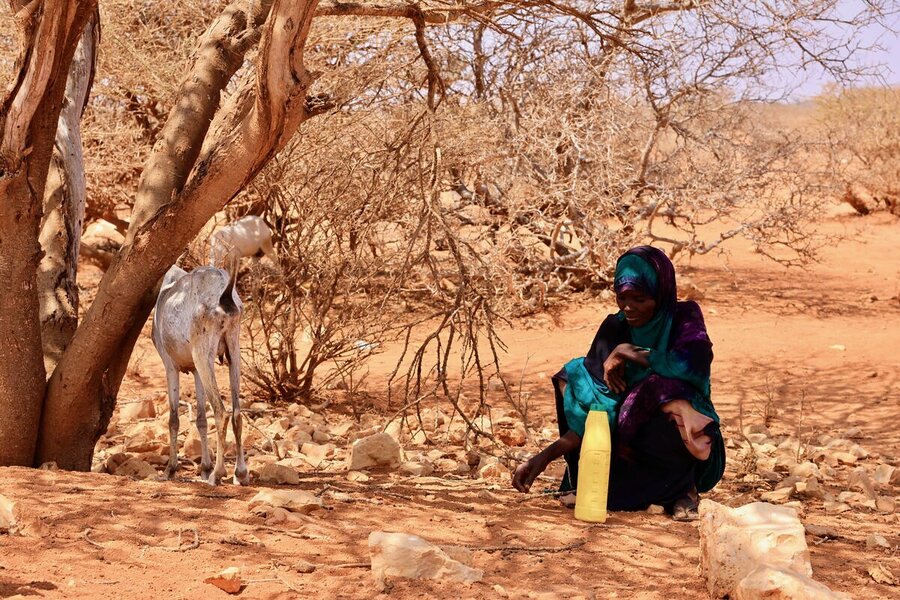
Maxamed’s village lies in one of the 30 districts where WFP has stopped delivering emergency food assistance for lack of funds. Countrywide, the funding crunch has also forced us to limit our nutritional support to children only – cutting off pregnant and breastfeeding women and girls – and shrink the number of WFP-supported health centres to just 120, down from more than 600 in 2025.
“In this town where we live, everyone is in a very difficult situation. There are hundreds of families sleeping hungry at night, and children do not attend school,” Maxamed says. “Some people go without food for two consecutive weeks, and don’t even get milk.”
Maxamed’s family used to be self-reliant thanks to their livestock. Her children went to school in town, and she helped teach other students. But when her goats began to slowly perish after two years of almost no rain, the family lost its source of income and food. Maxamed was forced to pull her children out of class, reduce meals, and borrow money.
“There is no normal day anymore,” she says. "In a week, it is possible to sleep four nights when we eat and the other three, we stay up hungry.”
As hardship mounts, Maxamed’s family could soon head to a displacement settlement – joining the millions of people projected to be displaced by drought this year.

Fadumo Abdikarim has already made that journey, driven by conflict and hunger. Today, she lives with her family in a displacement camp in the Somali capital, Mogadishu. Here, too, the funding crunch has forced WFP to reduce our assistance.
“There is severe hardship and need,” Abdikarim says, describing conditions at the crowded camp. “Some children have no fathers, some have no mothers, and many people have no jobs.”
Ready to save lives
The massive mobilization witnessed by WFP and our partners during Somalia’s last hunger crisis could similarly turn the tide today. With enough financing, WFP and our partners could quickly scale up, surging emergency food and nutrition assistance essential for children to recover from malnutrition and for families to rebuild their livelihoods.
“We are ready to save lives, but without continued support, communities could fall back into emergency hunger or worse,” Nuru says. “Further reductions would trigger serious humanitarian, security, and economic consequences that could extend beyond Somalia’s borders.”
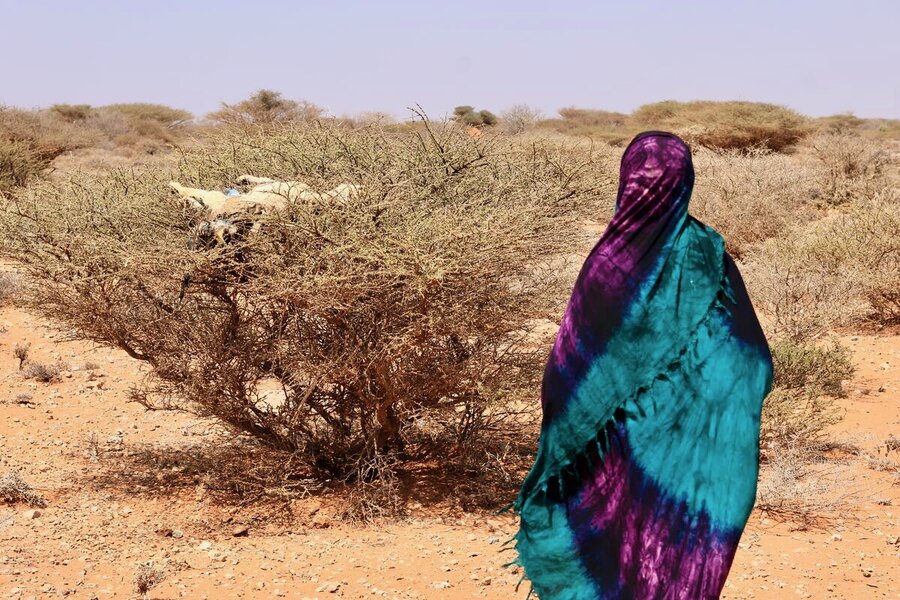
For families like Maxamed’s, who have already lost nearly everything, each day begins with the same questions: how to stretch the little that is left, and how long they can hold on before they, too, are forced to leave their homes.
As the sun goes down, she and her son walk home, carrying a small plastic container with a bit of water for their family.
“The animals are gone, and people are at risk,” Maxamed says. “If this harsh situation continues, without water and without food, people will die.”
Fatima Hirsi contributed to the story.
WFP’s work in Somalia is made possible thanks to support from Austria, Canada, Denmark, European Union, the Federal Government of Somalia, France, Germany, the Global Agriculture and Food Security Programme (GAFSP), Japan, JAWFP, Luxembourg, private donors, the Republic of Korea, Saudi Arabia, Spain, Sweden, Switzerland, UN CERF, UN SDG Fund, the United Kingdom (FCDO), the United States of America and the Zoetis Foundation.
WFP urgently requires US$131 million to continue supporting the most vulnerable people in Somalia through October 2026.