
War, hunger and hope in Gaza: WFP-EU art show draws crowds across Europe
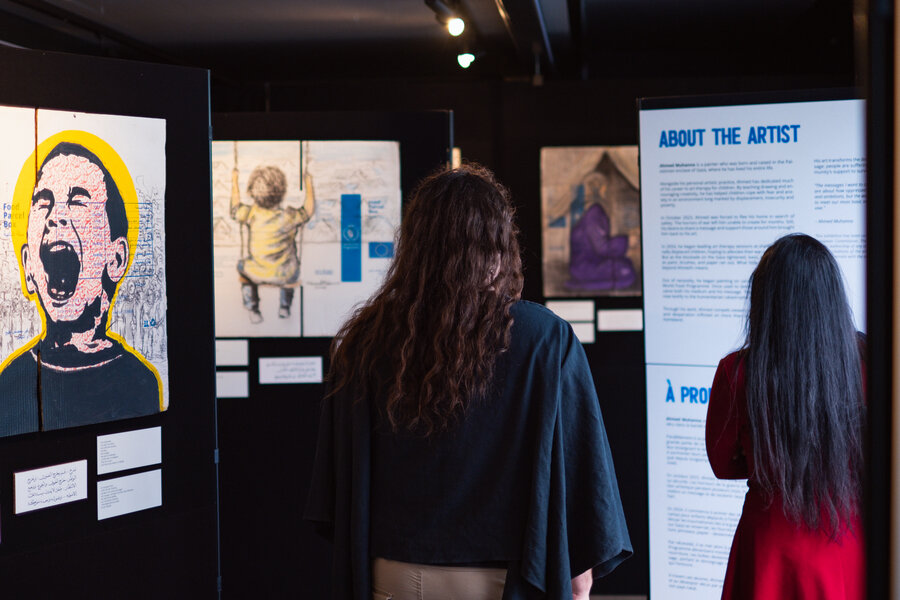
A boy stares out from a cardboard canvas, his mouth curved in a scream. On another wall, a little girl carries precious jugs of water and a crowd of people clutches empty pots, in bleak snapshots of hardship.
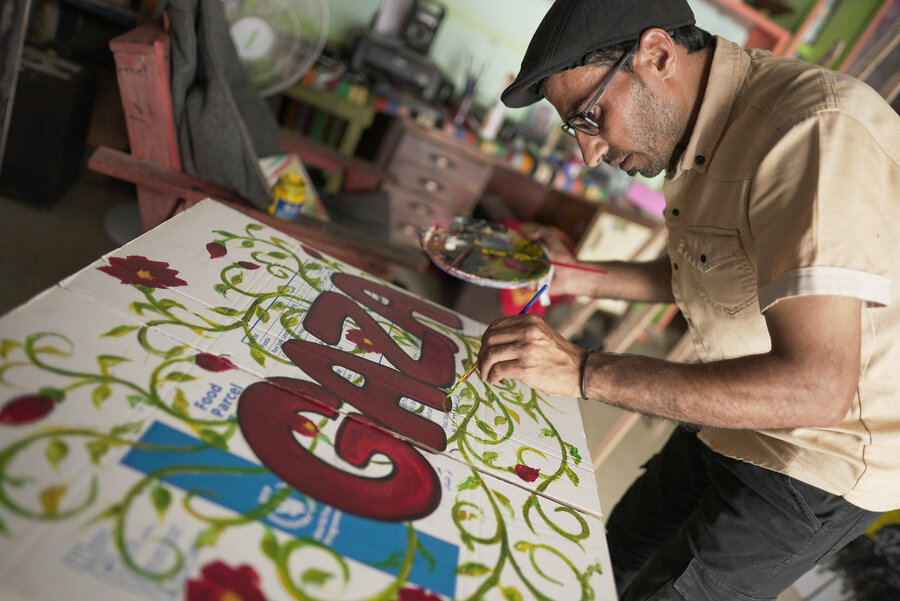
There’s a man with a bandaged head. A face covered with Arabic and English graffiti that includes the message “be human.” Also a blood-coloured handprint signed by Palestinian artist Ahmed Muhanna – who painted these and other works on World Food Programme (WFP) food boxes that became lifelines for people during Gaza’s two-year war.
These and other powerful images count among 60 of Muhanna’s paintings showcased in a travelling European Union-WFP exhibit that wraps up in Rome on Sunday 28 June. Housed in a truck with expandable space, it has hopscotched across 9 EU countries and 16 cities – from Brussels to Bilbao, Malmö to Marseille, Bonn to Barcelona – drawing tens of thousands of visitors since it opened nine months ago.
“Art is universal. It speaks to people,” says Caroline Van Nespen, Communications Officer and Campaign Manager at WFP’s Brussels office of the art show aimed to raise awareness about the Gaza crisis – and of WFP’s and the EU’s humanitarian response. “I think that’s why people become so moved. And it enables us to show the reality on the ground.”
Like many people in Gaza, Muhanna and his family were uprooted over and over during conflict that erupted in October 2023. At first, the father of three was too distressed to draw. Months later, he began offering art therapy to the Strip’s war-scarred children and took up his paintbrush once again.
“It made art for me more than just a creative practice,” Muhanna says of Gaza’s conflict that killed and injured tens of thousands, and led to soaring food insecurity, with half-a-million people experiencing famine-level hunger last year. “It became a means of bearing witness, preserving memory, and expressing both pain and hope.”
Food is hope in Gaza
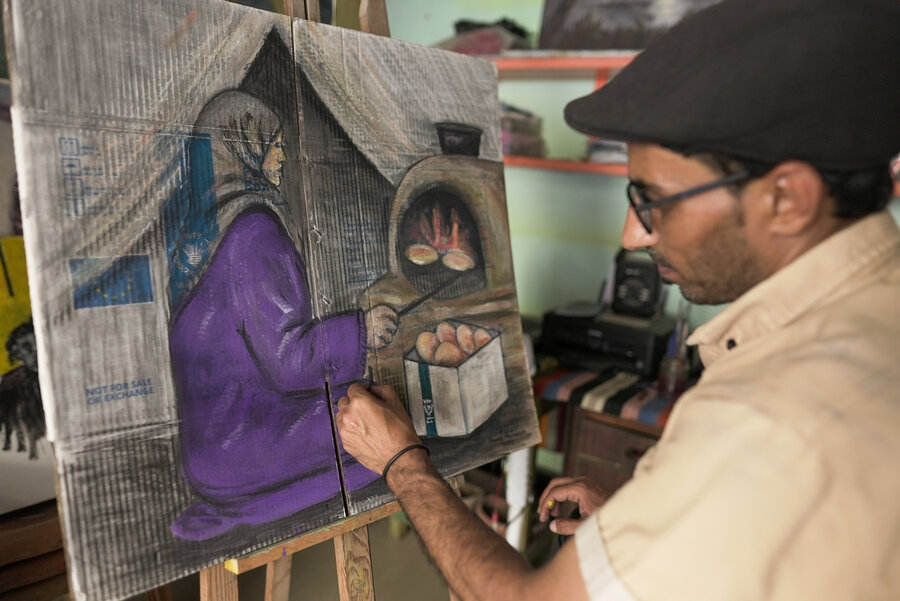
With Gaza’s borders often shuttered during the conflict and his acrylics running out, Muhanna began painting with leftover coffee and charcoal. He swapped canvas for WFP’s cardboard food boxes, whose contents still help support 1.6 million people in Gaza every month.
“These boxes weren’t just cardboard; they carried food that helped many families survive,” he says. “I wanted to say that food isn’t just about survival – it’s also about hope.”
Launched in Brussels last September, the exhibit initially travelled across six countries in northern Europe, parking in well-travelled public spaces. Some visitors heard about it through promotional spots and in the media. But many wandered in out of curiosity – as the tour’s organizers intended.
“I really wanted it to communicate to a wide audience, not only those already aware” about the situation in Gaza, Van Nespen says. “The art show aimed to be like street art — free and accessible.”
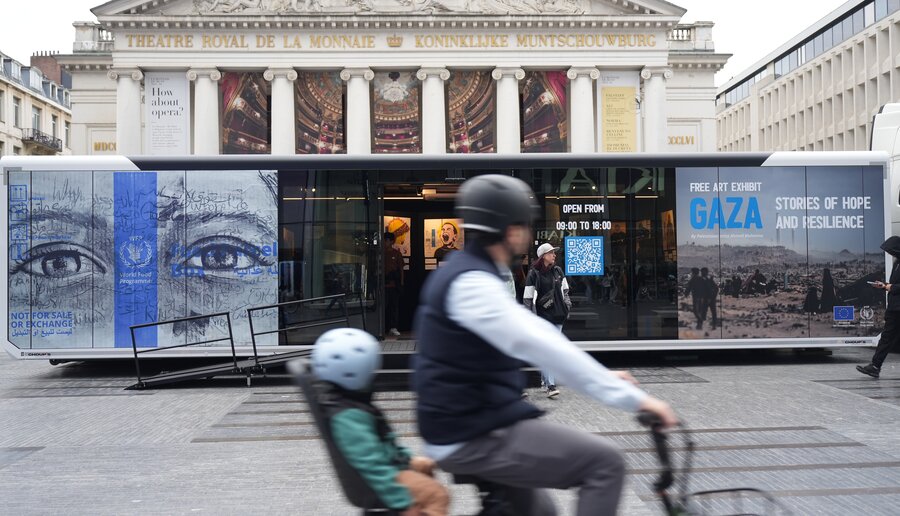
Van Nespen had hoped for 250 viewers a day. The initial five-week tour welcomed triple that number. Organizers decided to extend it for another seven weeks this year.
Pinned on the exhibit’s walls are small messages of praise and reflections from visitors.
“Courage to the Palestinian children,” reads one.
“Art brings something more human, more alive,” writes another from Gothenburg, Sweden.
“The drawings of Ahmed have moved me deeply,” said Hadja Lahbib, EU Commissioner for Equality, Preparedness and Crisis Management, at the exhibit’s opening last year. “They are intimate snapshots of what remains of life in Gaza. These paintings unveil the hell that is Gaza today but also the immense strength of the people living there.”
Fragile ceasefire, ongoing hunger
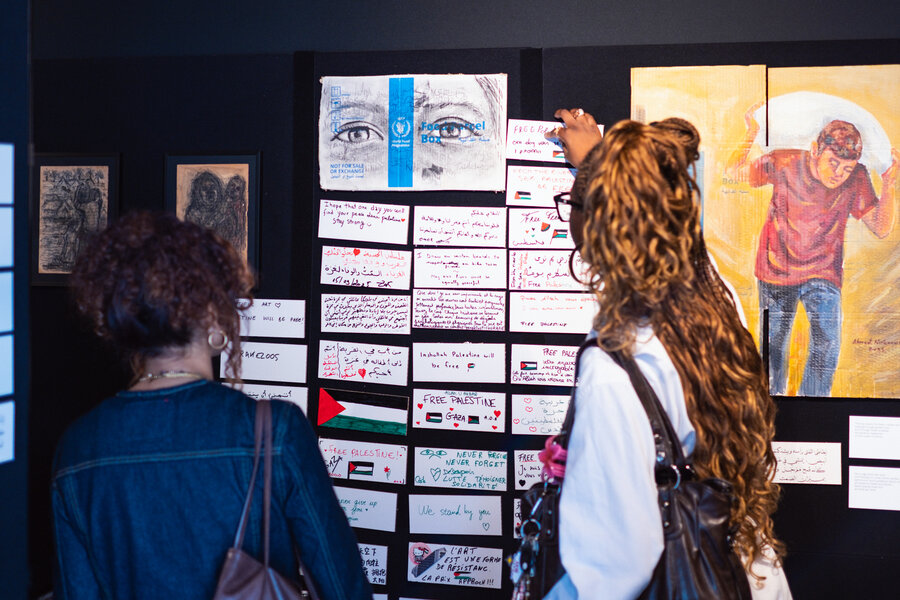
The art show has also become a space for dialogue on an often polarizing topic, says Van Nespen. She describes how visitors spend hours at the exhibit, which includes a documentary about Muhanna – who was unable to leave Gaza to participate in the tour.
“Visitors are very engaged, they are very moved,” she says. “They ask a lot of questions. Whether WFP is still operating in Gaza and how the situation is. They ask if they can donate, if they can support Ahmed.
“It’s so intimate, and when you have a lot of people, they start talking to each other.”
Eight months into the Gaza ceasefire, hunger is widespread. Fresh fruit and vegetables are especially scarce and humanitarian needs are immense. Most people are still jobless, living in tents and partially destroyed buildings – unable to restart shattered lives in an enclave buried in rubble.
In addition to food parcels, WFP reaches people each month with hot meals, bread and cash. We support retailers, traders and communities to recover their livelihoods and become self-reliant.
People need peace, safety and security to be able to recover, go back to their businesses and rebuild their food security and livelihoods.
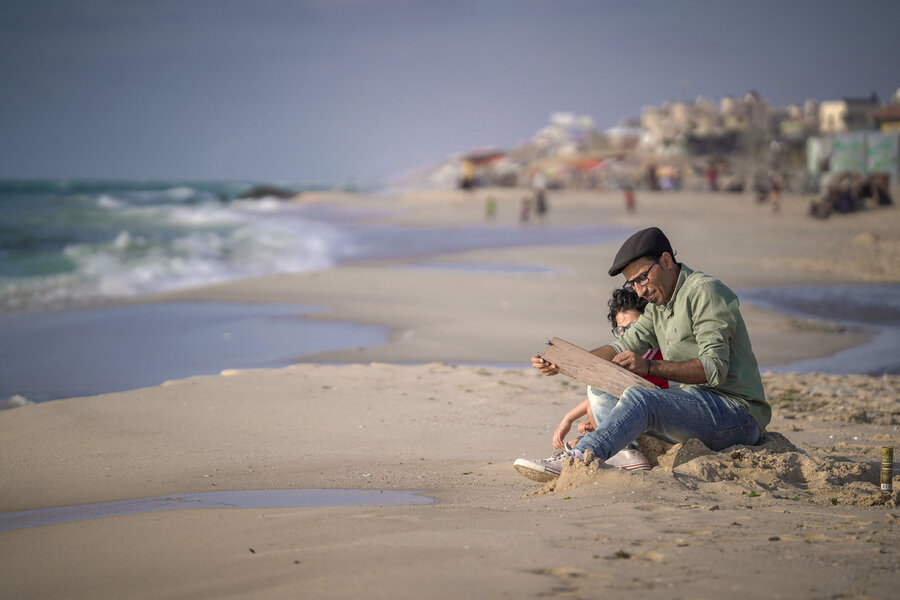
“People here live day to day,” Muhanna says. “Many rely on humanitarian aid and on what neighbours and relatives share with each other. Solidarity among people has become an important means of survival.”
Like all people in Gaza, the artist has lost family and friends to the war. He continues to paint and hopes for better days when his children can live without fear, he says, and reclaim their childhood.
“I dream that my family will be able to live a simple and dignified life: a safe home, food on the table and a future where survival isn’t the only concern,” Muhanna says, adding, “our dreams have become very modest. But to us, they are everything.”
Nour Hammad contributed to this story and in bringing the exhibit to life.